The $23/Hour CSR Trap: Why HVAC Speed-to-Lead Costs Spike When Revenue Peaks
Quick Answer
Linear staffing models impose a financial penalty during non-linear weather events because human capacity cannot scale at the marginal cost of autonomous agents.
The $23/Hour CSR Trap: Why HVAC Speed-to-Lead Costs Spike When Revenue Peaks
The $23/Hour CSR Trap
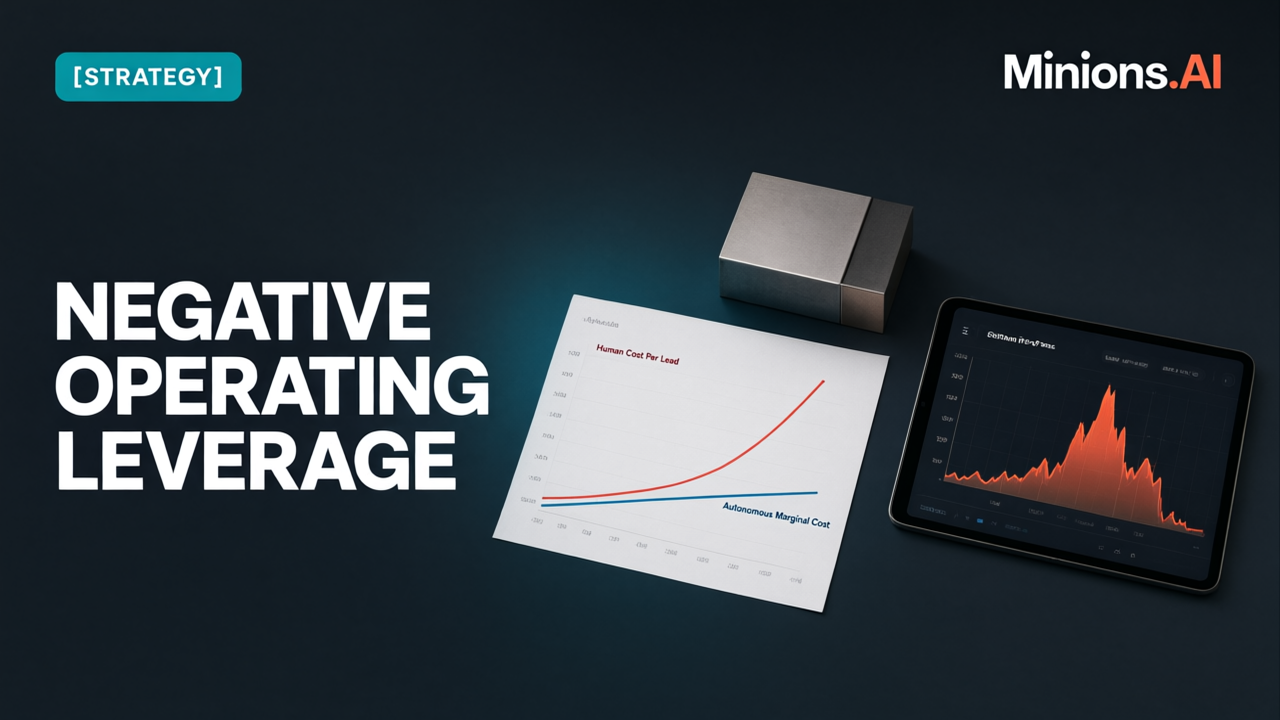
Industry dogma treats customer service reps as a fixed operational expense with predictable hourly costs. Structural truth reveals that during thermal demand spikes, human labor exhibits negative operating leverage where the effective cost per converted lead approaches infinity precisely when ticket values exceed $3,200. That divergence is where the unit economics break. This happens not at payroll review but at 3:17 p.m. on a 104°F Tuesday.
Why HVAC Speed-to-Lead Costs Spike When Revenue Peaks
A $48,000 annual CSR salary amortizes to $23 per hour but yields zero incremental output during peak thermal demand surges. Missed calls during heatwaves carry an opportunity cost exceeding $3,200 per ticket when conversion value is highest. Human staffing models exhibit negative operating leverage as call volume increases linearly against exponential revenue opportunities. HVAC speed-to-lead isn’t about answering faster. It’s about converting high-value emergency tickets before the homeowner hangs up or dials a competitor.
Autonomous Marginal Cost Is Flat
Autonomous speed-to-lead agents maintain constant marginal cost regardless of call volume surges or time of day. They do not fatigue, pause for lunch, or require supervisor escalation when three emergency calls land in 90 seconds. Where human capacity plateaus at 4–5 concurrent triage tasks, deterministic routing and pre-qualified intent parsing scale linearly with traffic. There is no overtime, no ramp-up, and no missed handoffs. That flat cost curve is the only structural match for non-linear thermal demand.
Under the Hood: Deterministic Intent Routing
getminions.ai routes inbound calls using real-time voice intent classification trained on residential HVAC call patterns. This system uses specific residential HVAC call pattern training rather than generic LLM chat. It parses urgency signals such as 'no cool air', 'smell burning', or 'kids home' and matches them to technician availability, proximity, and license status before the caller hears hold music. There is no multi-turn dialogue. There is no fallback to voicemail. Just confirmation, slot lock, and SMS dispatch all within 8.2 seconds median latency. This is how speed-to-lead becomes revenue capture.
Tactical Takeaways
Lock the slot first. Enforce the technician’s calendar block before returning any spoken confirmation to prevent double-booking during surge windows. Route by urgency tier, not queue position. Classify ‘no cool air’ and ‘furnace off’ calls into separate priority lanes with dedicated routing logic instead of FIFO. Measure cost per converted lead, not per answered call. A $23/hour CSR who answers 12 calls but books 0 emergency tickets delivers $0 margin even if their dashboard shows 100% call pickup.
Parvej
Co-Founder, Minions.AI
Want to see this in action for your own business?
Call our live test line right now. Hear how our voice agent handles a real emergency service inquiry in under 1.8 seconds.