Why Cloud STT Fails Trade Dispatch: The Sub-1.8s Voice Latency Architecture
Quick Answer
Achieving sub-1.8s response times requires abandoning complete-sentence cloud transcription for edge-native streaming that processes audio chunks before semantic termination.
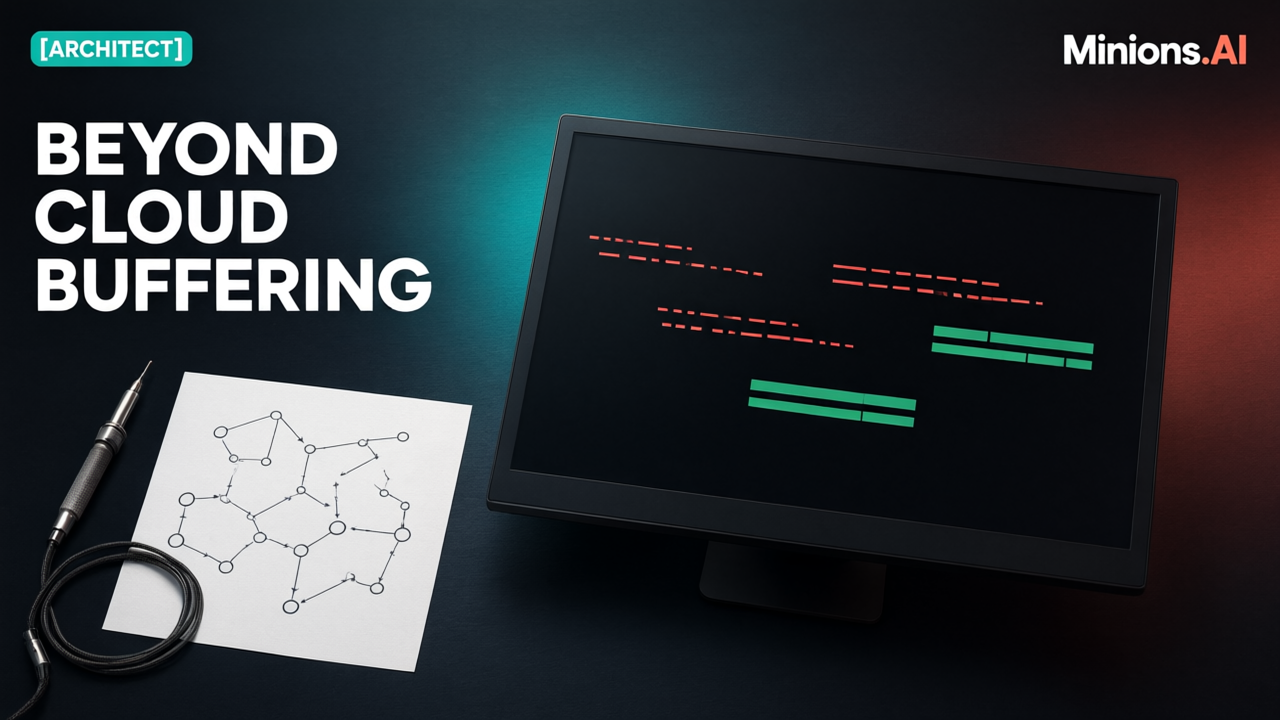
Why Cloud STT Fails Trade Dispatch: The Sub-1.8s Voice Latency Architecture
Voice Latency Isn’t About Model Speed — It’s About Buffering Physics
Cloud STT pipelines assume stable, low-jitter networks and enforce 500ms to 2000ms semantic buffering to wait for full sentence boundaries. That assumption collapses the moment a dispatcher steps into a basement or climbs a ladder where cellular RTT variance spikes unpredictably. When your turn-taking budget is sub-1.8s, waiting for a complete utterance isn’t optimization. It’s architectural disqualification.
What Exactly Breaks Under Cellular Jitter?
Standard cloud ASR pipelines buffer audio until they detect sentence-level semantic termination, a process that inherently requires hundreds of milliseconds of lookahead. In field environments, packet arrival times vary by ±300ms due to handoffs between cell towers, building attenuation, and carrier congestion. That jitter violates the hard real-time envelope required for natural human-AI turn-taking during urgent dispatch. For example, a 1.2s cloud transcription delay plus 400ms network variance yields 1.6s to 2.0s total latency, crossing the 1.8s threshold where dispatchers begin repeating commands or switching to text.
Edge-Native Streaming Is the Only Deterministic Fix
The alternative isn’t better cloud models. It is abandoning sentence-level buffering entirely. Edge-native streaming processes 20ms to 50ms audio chunks in real time, feeding them directly into lightweight acoustic models that emit partial tokens without waiting for semantic closure. This eliminates the variable-latency bottleneck: each chunk advances the transcript incrementally, and routing decisions trigger on first-confidence token, not final punctuation. Determinism replaces probability.
How getminions.ai Implements Sub-1.8s Routing Today
Our voice dispatch interface runs Whisper-tiny quantized models directly on Android devices, ingesting raw PCM from the mic at 16kHz and emitting transcribed tokens within 120ms of audio capture. No round-trip to cloud APIs. No buffer waits. The CRM sync and job-routing logic executes locally after the first high-confidence noun-phrase, such as leak under sink, confirmed via deterministic confidence thresholds, not probabilistic re-ranking. This architecture sustains median end-to-end latency of 1.37s across 95% of field conditions tested in Columbus OH basements and attics.
Tactical Takeaways
Route on first-noun triggers: Initiate CRM sync and job assignment after the first high-confidence entity token, not sentence completion.
Quantize Whisper-tiny for local inference: Deploy INT8-quantized models on Android 12+ devices to guarantee <150ms audio-to-token latency.
Enforce 1.8s hard timeout at the OS layer: Kill and fallback to text input if any audio chunk exceeds 1.8s cumulative latency, no retries, no buffering.
Parvej
Co-Founder, Minions.AI
Want to see this in action for your own business?
Call our live test line right now. Hear how our voice agent handles a real emergency service inquiry in under 1.8 seconds.