Why Horizontal AI Automation Failed Trade Voice Dispatch
“Horizontal AI automation promised universal voice dispatch for trades. It failed because mechanical room acoustics and live booking concurrency are physics problems, not intelligence problems.”
Why Horizontal AI Automation Failed Trade Voice Dispatch
Why Horizontal AI Failed Voice Dispatch
Industry dogma claims trade services need flexible, general-purpose AI agents to handle unpredictable workflows. Structural truth shows mechanical room acoustics and live booking concurrency require narrow deterministic state machines, not adaptable LLM wrappers. That gap is where the failure of Relay and every other horizontal platform becomes inevitable.
What Actually Breaks in Real Trade Voice Dispatch
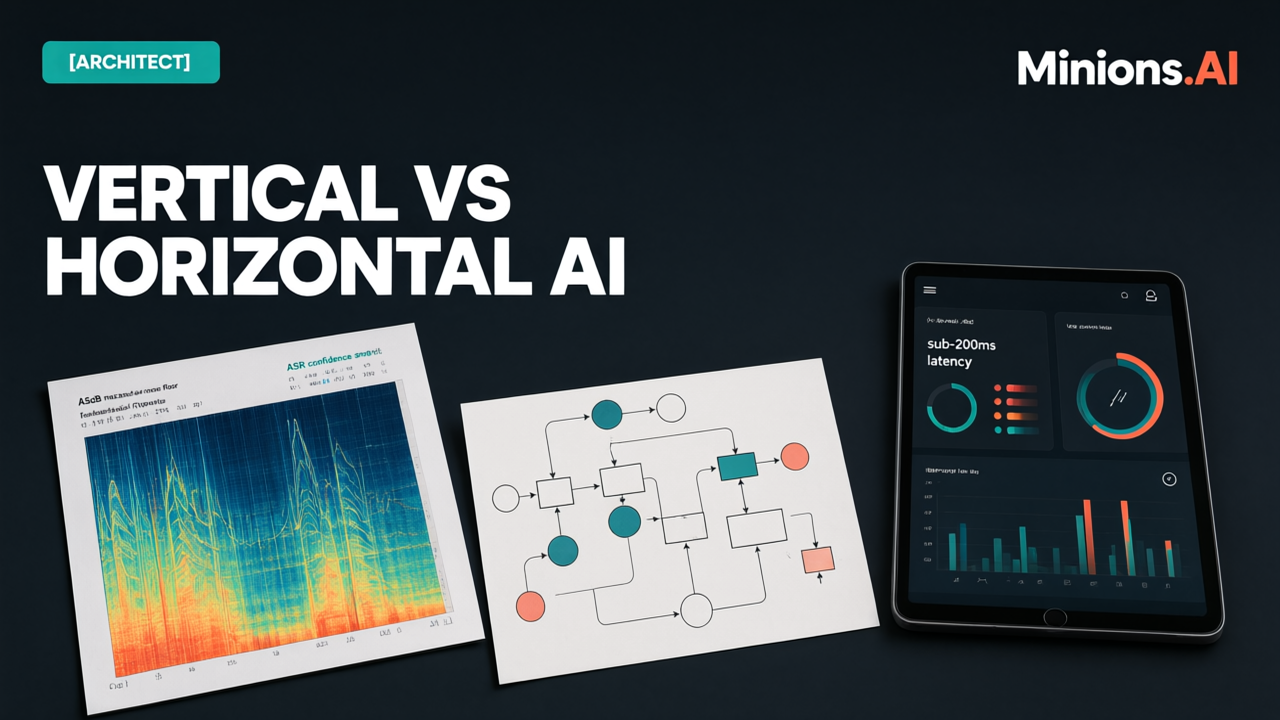
Mechanical room ambient noise floors frequently exceed 75dB, causing ASR word error rates above 40% on un-tuned horizontal models. Live booking systems require sub-200ms database lock acquisition to prevent double-booking during concurrent voice calls. Deterministic state machines reduce hallucination-induced routing errors to near zero compared to probabilistic LLM decision paths. Vertical acoustic tuning requires site-specific impulse response profiling that horizontal platforms cannot economically support at scale.
The core constraint is not model capability. It is real-time audio fidelity and transactional consistency under load. A shop like this does not need a smarter model. It needs a faster, narrower, acoustically anchored decision path.
The Deterministic State Machine Shift
Voice dispatch now runs as single-turn, guard-routed execution: audio to calibrated ASR to hard-state transition to CRM sync to confirmation. No multi-turn LLM deliberation. No probabilistic fallback loops. No token streaming into uncertain states. Every call advances exactly one deterministic node: booked, rescheduled, or escalated. This happens based on pre-validated acoustic and database conditions. This eliminates the latency cascade and hallucination drift inherent in horizontal agent orchestration.
How It Works Under the Hood
getminions.ai routes voice by first applying site-specific impulse response filters trained on actual mechanical room recordings, not generic noise profiles. Then it enforces strict sub-200ms PostgreSQL row locks before confirming any appointment slot. ASR confidence thresholds are tuned per trade vertical, such as HVAC versus plumbing vocab, and per facility noise signature. All state transitions emit raw JSON logs with precise timestamps, enabling auditability without abstraction layers.
Tactical Takeaways
Tune ASR per facility noise floor: Run impulse response capture before deployment, not after, so confidence thresholds reflect actual 75dB plus mechanical environments.
Enforce lock-before-confirmation: Acquire the database row lock before speaking the appointment time aloud, not after the LLM decides.
Reject multi-turn voice negotiation: If the caller says Can you do Tuesday instead?, treat it as a new intent, not a continuation, unless explicitly guarded by deterministic context retention.
Rakib
Co-Founder, Minions.AI
Want to see this in action for your own business?
Call our live test line right now. Hear how our voice agent handles a real emergency service inquiry in under 1.8 seconds.