Why Multi-Agent Voice AI Fails at Sub-1.8s Routing
“Multi-agent orchestration is killing your voice AI latency. Every extra LLM hop adds 400ms, pushing response times past the 1.8s threshold where callers hang up.”
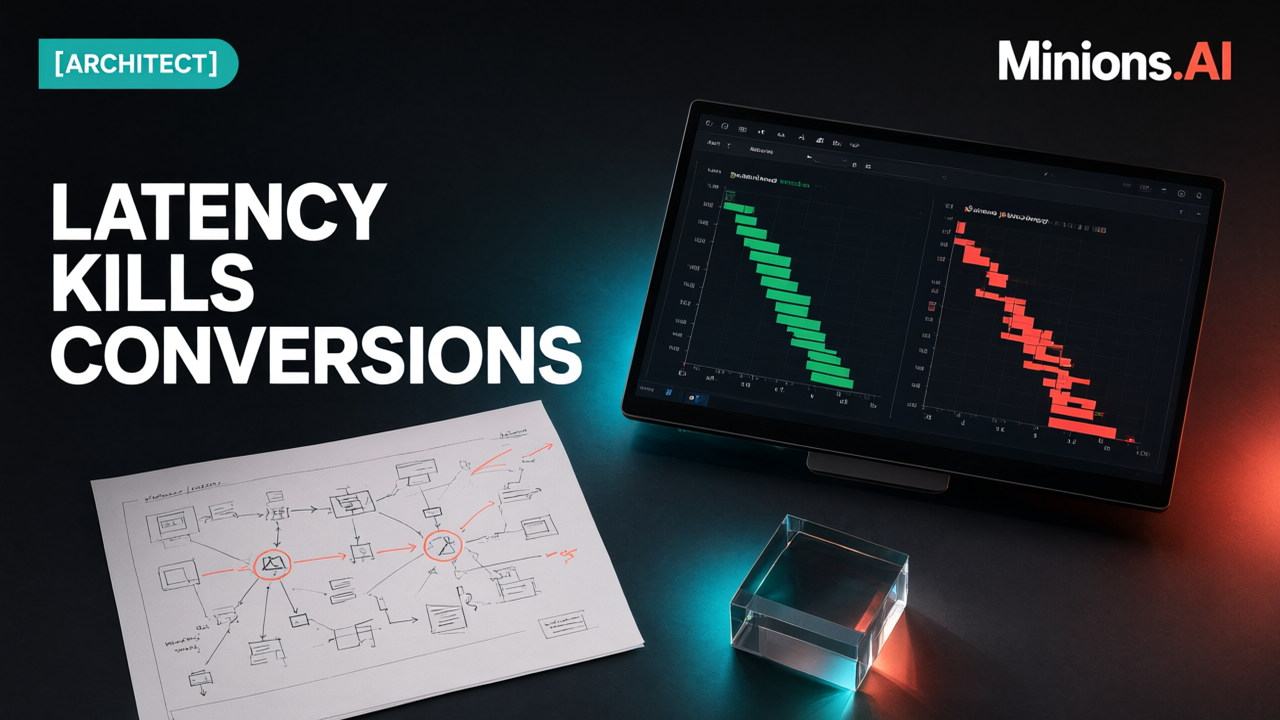
Why Multi-Agent Voice AI Fails at Sub-1.8s Routing
Voice AI Fails When Latency Exceeds 1.8 Seconds
Multi-agent voice stacks treat routing as a reasoning problem. But voice is a real-time channel governed by human perception thresholds, not inference depth. The 1.8s ceiling is not arbitrary. It is the point where callers disengage, hang up, or dial a competitor. That gap is where deterministic edge routing begins.
What Actually Breaks Multi-Agent Voice Routing
Each LLM summarization hop between agents adds roughly 400ms of unavoidable network and inference latency. This is structural floor, not variability or occasional spikes. For a three-agent handoff involving intent, schedule, and confirmation, that is 1.2s before audio I/O. This leaves zero headroom under 1.8s. Caller abandonment rates spike exponentially once voice response latency exceeds 1.8 seconds. Deterministic state machines execute routing decisions in under 50ms compared to 2s+ for probabilistic agent handoffs.
Deterministic Edge Routing Is the Architectural Fix
Instead of chaining agents to reason about context, route with pre-compiled state machines. These resolve intent, availability, and CRM sync in one atomic pass. There is no summarization. No token streaming. No fallback loops. Raw JSON logs provide ground-truth debugging data that natural language summaries actively obscure. This shifts reliability from probabilistic guesswork to predictable execution. This is exactly what HVAC dispatchers need during peak season surge.
How It Works Under the Hood
Routing logic executes on the edge, parsing DTMF or ASR output directly into a finite-state machine. This maps to calendar sync, technician assignment, and SMS confirmation all in under 50ms. There are no intermediate LLM calls. No context re-encoding. Every decision path is pre-validated and traceable via raw JSON event logs, not hallucinated summaries. That is how you sustain sub-1.8s routing at 120 calls per minute without dropping a single HVAC emergency ticket.
Tactical Takeaways
Replace agent handoffs with compiled routing logic. Each hop adds 400ms of guaranteed latency, not optional overhead.
Parse ASR output directly into state transitions. Natural language summaries introduce noise and delay.
Use raw event logs for debugging. They show exact timing, queue depth, and decision paths without abstraction loss.
Measure end-to-end p95 voice routing time across all call flows, not just ideal demos. Multi-agent stacks fail silently in tail latency.
Parvej
Co-Founder, Minions.AI
Want to see this in action for your own business?
Call our live test line right now. Hear how our voice agent handles a real emergency service inquiry in under 1.8 seconds.