Why Your Roofing Storm Damage Estimates Get Rejected (It Is Not the Price)
Quick Answer
Insurance claim denials are data formatting failures, not pricing disputes.
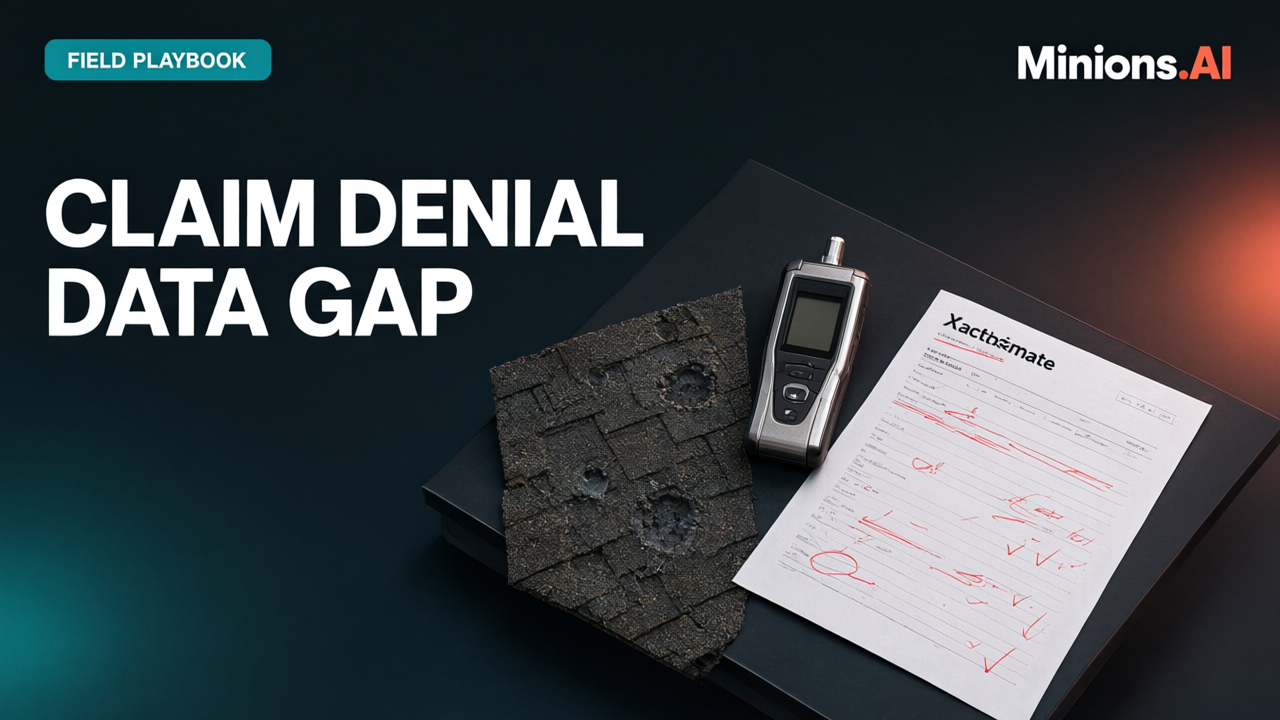
Why Your Roofing Storm Damage Estimates Get Rejected (It Is Not the Price)
It Is Not the Price — It Is the Photo Metadata
Rejections are not pricing arguments. They are data validation failures in carrier underwriting engines that auto-flag missing granule loss timestamps, untagged hail impact zones, or uncross-referenced Xactimate codes. That gap is where the next section starts.
Why 30% of Estimates Get Flagged on Day One
Adjusters deny an average of 30% of initial storm damage estimates due to missing granule loss photos or improper code cross-references. Automated carrier auditing systems scan every line item for embedded visual proof, depreciation schedule alignment, and material waste factor justification rather than just dollar totals. If a shingle replacement line omits a timestamped close-up showing bruising depth and substrate exposure, the system rejects it before human eyes ever see it.
The Single-Turn Documentation Loop
Instead of multi-step supplement cycles, getminions.ai’s Rex crew captures required evidence in one pass. This process uses geo-tagged, time-stamped, carrier-code-annotated photos synced directly to Xactimate line items during tarping or first inspection. There is no manual tagging. There is no post-visit rework. Deterministic capture replaces probabilistic follow-up.
Under the Hood: Photo-to-Xactimate Sync
Rex enforces structured intake at the point of contact. Voice-guided photo capture triggers automatic EXIF parsing, validates GPS plus timestamp plus lighting conditions, and cross-links each image to a specific Xactimate code such as R12.3-HAIL-BRUISE. The system embeds carrier-specific depreciation logic into the estimate header. This is not OCR post-processing. It is real-time documentation scaffolding.
Tactical Takeaways
Capture the bruise before the bid. Require geo-tagged, macro-lit shingle bruising photos at the moment of tarping rather than after. Map every line to a carrier code. Assign Xactimate line items only when paired with a validated photo ID and depreciation schedule tag. Sync metadata, not just images. Embed timestamp, GPS, lighting condition, and code reference directly into the image EXIF rather than using a separate note or PDF appendix. Run the audit before submission. Use Rex’s pre-flight validator to flag missing waste factors or uncross-referenced materials before the carrier’s engine does.
Parvej
Co-Founder, Minions.AI
Want to see this in action for your own business?
Call our live test line right now. Hear how our voice agent handles a real emergency service inquiry in under 1.8 seconds.